May Themes and Activities
It’s May! Find a list of May themes and activities for kids. Great ideas for developing lesson plans and keeping the kids engaged with what’s happening in the days of May.
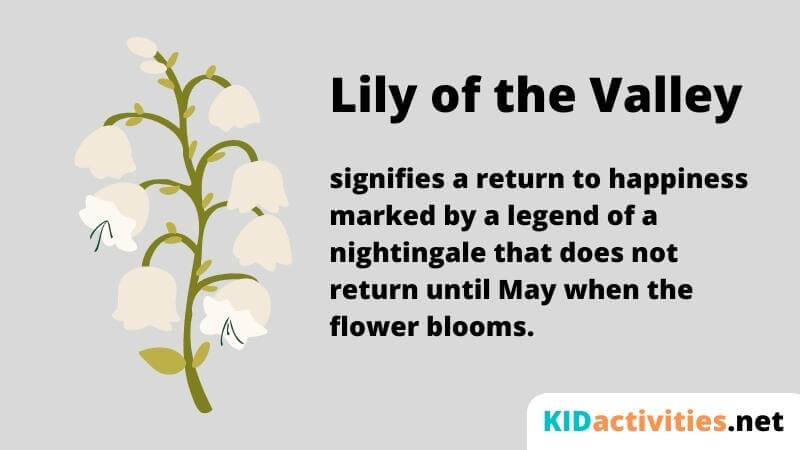
FLOWER: Lily of the Valley. Lily of the Valley signifies a return to happiness marked by a legend of a nightingale that does not return until May when the flower blooms.
ZODIAC SIGN: Taurus (The sign of the Bull). Taurus is between April 21 – May 20.
Positives traits of Taursus are:
Patient and reliable, Warmhearted and loving, Persistent and determined, Placid and security loving
May 21 to June 21 is Gemini the Twins.
Postive Gemini traits are: Adaptable and versatile, Communicative and witty, Intellectual and eloquent, Youthful and lively
Mother’s day dates by year
DOING THE DAYS OF MAY
MOTHER’S DAY – In the United States, Mother’s Day is celebrated on the second Sunday of May.
In some countries it is on dates that are significant to the majority religion or to historical dates.
- Mother’s Day 2019 – May 12
- Mother’s Day 2020 – May 10
- Mother’s Day 2021 – May 9
- Mother’s Day 2022 – May 8
- Mother’s Day 2023 – May 14
- Mother’s Day 2024 – May 12
- Mother’s Day 2025 – May 11
Memorial Day dates by year
MEMORIAL DAY (Celebrated last Monday of May) See ideas in Red, White & Blue Theme!
- Memorial Day 2018 – May 28
- Memorial Day 2019 – May 27
- Memorial Day 2020 – May 25
- Memorial Day 2021 – May 31
- Memorial Day 2022 – May 30
- Memorial Day 2023 – May 29
- Memorial Day 2024 – May 27
- Memorial Day 2025 – May 26
May Activity Calendar
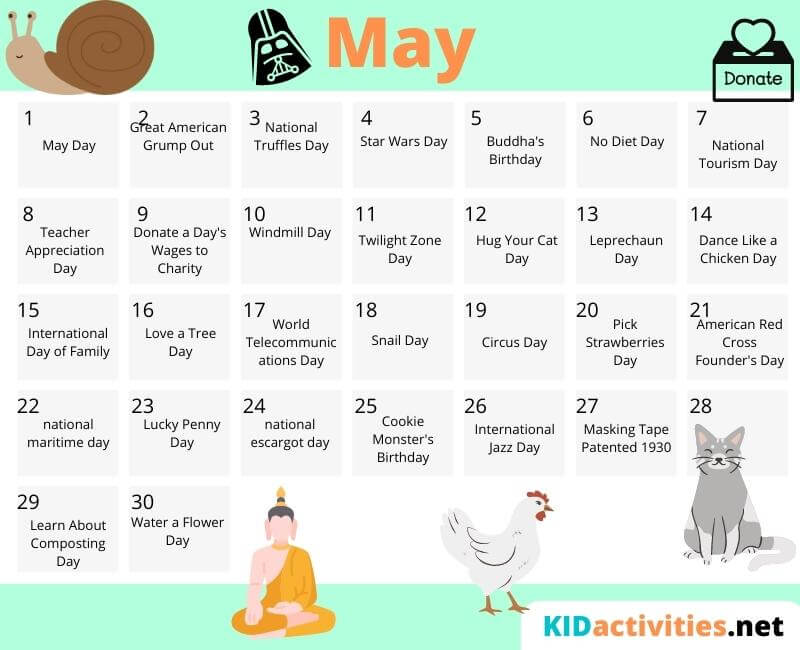
Other events and days to celebrate in the month of May
1. May Day
1. Loyalty Day (What IS loyalty? What makes a good friend? What are the traits? What is NOT a good friend? What are the traits. How does a loyal friend treat their friends?)
1. Mother Goose Day
1. Hawaiian Lei Day (See page bottom)
1. Save the Rhino Day
1. School Principal’s Day
1. World Asthma Day
2. Great American Grump Out
2. Baby Day
2. Brothers and Sisters Day
2. National Play Your Ukulele Day (Introduce kids to ukulele music. Some pieces by “Iz” are wonderful!)
3. National Truffles Day
3. National Wear Two Different Colored Shoes (That’s an easy one!)
3. National Day of Prayer
3. Paranormal Day
3. Public Radio Day
3. World Press Freedom Day
3. Lumpy Rug Day (???? No idea what that one means…) Maybe play a version of “Twenty Questions”? Hide something under a small throw rug–and have children guess what is under the rug? Play it following the rules of “Twenty Questions”!
4. Star Wars Day (Watch a ‘”Star War” movie of course! Don’t forget the popcorn!) Do you have any old Star War figures or Legos? Pull them out and play…
4. National Weather Observers’ Day
4. Bird Day (Choose from the many ideas in the Bird Theme!)
4. National Candied Orange Peel Day
5. Cinco de Mayo (Visit Mexican Theme)
5. Children’s Day (Japan)
5. Buddha’s Birthday
5. National Hoagie Day (See page bottom)
5 Oyster Day
5. Join Hands Day
5. National Scrapbooking Day
5. Space Day
6. No Diet Day
6. Beverage Day (How about something from the “Smoothies, Coolers, & Shakes” Page?!)
6. No Homework Day (Come on Teachers! The kids will love it if you officially celebrate this day! Be sure to tell them it’s in honor of No Homework Day…)
6. Nurses Day
6. World Laughter Day (Visit Jokes pages and/or have fun & laugh with Tongue Twisters & Games!) Remember that young kids ‘don’t get’ jokes but they DO love Knock-Knocks!
6. National Tourist Appreciation Day
7. National Tourism Day
Have kids think about what people may like about visiting your town/city/state! Talk about it…have children write and/or draw pictures of individual attractions. Compile all into a booklet about “My Town or City”
7. Accountant’s Day
7. Children’s Mental Health Awareness Day
8 National Teacher Appreciation Day (Always on the Tuesday of first full week of May)
8. Harry Truman Birthday
8. Iris Day
8. No Socks Day (That’s another EASY one!!!)
8. World Red Cross Day
8. VE Day
9. Donate a Day’s Wages to Charity (How about collecting pennies and nickles for a Service Project?–Start several days before the 9th) Visit Community Services Pages!
9. National School Nurse Day
9. Receptionists’ Day
10. Windmill Day
10. Clean Up Your Room Day…Have a ‘Cleaning/organizing party’…kids sign-up for what they want to do–when complete–all participants celebrate. (I’ve done this in child-care programs as well as at home. At home–we all cleaned what we chose for 20 minutes and the house was spotless–kids’ bedrooms don’t go on list LOL! The rest of the day was devoted to FUN)
11. Twilight Zone Day
11. Minnesota Statehood
11. Eat What You Want Day
11. Child Care Provider Day
Military Spouse Appreciation Day (Always the Friday before Mother’s Day)
12. Limerick Day
12. Hug Your Cat Day
12. National Nutty Fudge Day (See recipe page bottom)
12. Migratory Bird Day (Always the second Saturday in May)
13. Frog Jumping Day (Visit Frog Theme)
13. Leprechaun Day (There’s some Leprechaun fun in the St. Patrick’s Day pages…Scroll down to the Games & Art/Craft pages. there are many ideas that are just Leprchaun and not St. Paddy Day)
13. Rural Life Sunday
13. Tulip Day (See page bottom for “Handprint Tulip”)
14. Dance Like a Chicken Day (Visit Chicken & Pigs Page)
14. Beginning of Lewis and Clark Expedition
15. International Day of Families
15. National Chocolate Chip Day (Yumm..serve chocolate chip cookies or make some trail mix adding chocolate chips to it!)
15. Straw Hat Day
15. Police Officer’s Memorial Day
16 Love a Tree Day (See page bottom for wonderful idea!)
16. Biographer’s Day
16. National “Sea Monkey” Day
16. National Wear Purple for Peace Day (Visit Purple Color Theme page)
17. World Telecommunications Day
17. Pack Rat Day
19. Circus Day (Visit Circus/Carnival Theme Pages)
19 Armed Forces Day (Always third Saturday of month)
19 Boy’s Club Day
20. Pick Strawberries Day
20. Weights and Measures Day (See page bottom for ideas)
20. Be a Millionaire Day (Talk about what kids would do if they had a million dollars.)
20. Eliza Doolittle Day
20. Neighbor Day
21. American Red Cross Founder’s Day
21. National Memo Day
21. National Waiters and Waitresses Day
21. Victoria Day (CA)
21. National Endangered Species Day (See two ideas page bottom)
22. National Maritime Day
22. Wright Bros Patented the Airplane (See idea page bottom)
22. Buy a Musical Instrument Day (See idea page bottom)
23. Lucky Penny Day
23. World Turtle Day
23. South Carolina Statehood
24. National Escargot Day (Idea at page bottom)
24. Brother’s Day
24. Morse Code Day
25. National Missing Children’s Day
25. Cookie Monster’s Birthday
25. National Tap Dance Day
26. International Jazz Day (Always the Saturday of Memorial Day weekend)
26. Sally Ride Day
27. Masking Tape Patented 1930 (See idea at page bottom)
27. Sun Screen Day (Talk about the importance of sun screen and how the sun can damage skin when it’s not protected)
27. Golden Gate Bridge Opens 1937
29. Learn about Composting Day
29. Rhode Island Statehood
29. Wisconsin Statehood
29. John Kennedy Birthday
30. Water a Flower Day (Visit Flower Theme and or Garden Theme
30. Loomis Day —Mahlon Loomis (1826-1886), believed it was possible to harness the upper atmosphere’s electrical currents to successfully transfer telegraph messages without wire.
31. National Macaroon Day
31. Save Your Hearing Day
31. “What You Think Upon” Grows Day——-Ask kids what they think this means! Talk about it. It means…what you think creates your reality. So, spend the day thinking positively.
31. World “No Tobacco” Day
MAY IS THE MONTH OF:
- Family Wellness Month
- Foster Care Month
- Freedom Shrine Month
- Get Caught Reading Month
- Gifts From The Garden Month
- GO FETCH! Food Drive for Homeless Animals Month (See page bottom)
- Grapefruit and Kiwi Month
- Hamburger Month
- Haitian Heritage Month
- Heal the Children Month
- Healthy Vision Month
- International Civility Awareness Month
- INVENTOR’S MONTH (See page bottom for great idea!)
- Jewish-American Heritage Month
- Latino Books Month
- Meditation Month
- Mental Health Month
- Military Appreciation Month
- Moving Month
- Older Americans Month
- Personal History Month
- Photo Month
- Potatoes and Limes Month
- Physical Fitness & Sports Month
- Revise Your Work Schedule Month
- Salad Month
- Salsa (the food) Month
- SMILE MONTH (See below)
- Tennis Month
- Ultra-violet Awareness Month
- Vinegar Month
- Young Achievers of Tomorrow Month
- Youth Traffic Safety Month
- American Wetlands Month
- Asian American & Pacific Islander Heritage Month
- Better Hearing & Speech Month
- Barbecue Month
- Bike Month
- Blood Pressure Month
- Carrots and Cauliflower
- Clean Air Month
- Community Living Month (Ontario, Canada)
- Date Your Mate Month
- Creative Beginnings Month
- EcoDriving Month
- EGG MONTH (Check out the EGG THEME–that is NOT Easter related!)
May Activity Ideas

MAY 5 IS NATIONAL HOAGIE DAY
SANDWICH ART: Make a hoagie sandwich that looks back at you! Ingredients:
| Hoagie buns | Sliced lowfat cheese |
| Lean luncheon or deli meat | Shredded carrots, lettuce, or sprouts |
| Olives | Cherry tomatoes |
| Miscellaneous condiments (mustard, reduced fat mayonnaise, etc) | Toothpicks (or broken spaghetti pieces) |
| Clean work surface and hands |
Make hoagie sandwich, using desired ingredients. On one end of the sandwich, use toothpicks or broken spaghetti pieces to position olives for eyeballs and cherry tomato for nose.
Arrange shredded carrots, lettuce, or sprouts on top for hair. If desired, stick a small piece of lunch meat out of the “mouth” for a tongue.
NOTE: Be sure to remove all toothpicks before eating!
MAY 12 NATIONAL NUTTY FUDGE DAY
MICROWAVE FUDGE WITH NUTS
- 1 pound powdered sugar
- 1/2 cup cocoa
- 1/4 cup milk
- 1/4 pound margarine (or butter)
- 1 Tbsp. vanilla
- 1/2 cup chopped nuts
1. Blend powdered sugar and cocoa in mixing bowl then add milk and butter, cook in Microwave Oven for 2 minutes. ( do not mix these ingredients, merely place in the bowl)
2. Remove bowl from microwave and stir to mix ingredients.
3. Add vanilla and nuts and stir until blended.
4. Pour in greased container and place in freezer for 20 minutes or refrigerator for 1 hour.
5. Cut and serve. Yield: 60 pieces. (Recipe is from KidActivities Easy Candy Making Category)
MAY 13 NATIONAL TULIP DAY
MAKE THE “HANDPRINT TULIPS” AS SHOWN!
MAY 16 ~ IS LOVE A TREE DAY!
Find a special tree on your playground or yard and explain that you can adopt that tree as your “pet” plant. Have a contest to name the tree. (This is a great way to use a graph!)
- Take photos of your tree and encourage the children to draw pictures of it during different seasons.
- Ask children to hug your tree. What does it feel like? What does it smell like? Can you hear your tree?
- Measure the tree
- Read books, have picnics, or sing songs under your tree. (I love this idea! Barb)
MAY 20 IS WEIGHTS AND MEASURES DAY. This is a great day to have some fun with MEASUREMENT
Offer measuring tapes, rulers, thermometers, balance scales, measuring cups, clocks, hour-glasses, and stand-on scales
Help children weigh and measure everything Shoes, feet, living plants, table heights, how many minutes it takes to eat lunch, If children are young – how long each child naps, etc.
Record measurements, repeat often, and discuss what changes and what stays the same. (Idea is taken from KidActivities Mixing Math and Fun Category)
21 NATIONAL ENDAGERED SPECIES DAY
#1. In Minnesota a group of second graders did this project – but all grades can do the same!
To one 2nd-grade class, the study of endangered animals was a vague subject. They grasped the definitions of words like “threatened” and “extinct,” but it was difficult to imagine animals that were so familiar to them – like pandas – simply not existing.
A student-led fund-raising project in support of endangered animals brought the issue into focus.
FIRST – The students prepared by reading a play about rainforest animals. They worked cooperatively to chart information about a variety of endangered animals and make illustrated books about each one.
NEXT – The children pulled key ideas from what they’d learned and created flyers that they distributed to households near the school.
In the flyers, the students informed their neighbors about issues facing animals and asked them to contribute aluminum cans and pennies, which the students counted and used to adopt two animals from the local zoo.
PENNNIES FOR PANDAS AND OTHER ENDANGERED
ANIMALS. The children also organized a school-wide contest to see which class could contribute the most pennies.
In celebration of the successful fund-raising drive, the students performed the play about rainforest animals for parents and fellow students.
Even before the curtain rose, they knew they were already playing one of the most important roles of their lives: Caretaker of the Earth.
Adapted from “Route to Reform: K-8 service-learning Curriculum Ideas,” 1994-95 National Youth Leadership Council.
#2 PLAY “ENDANGERED ANIMAL” CHARADES
Young children are often surprised to learn that their favorite animals from books and in zoos are not prevalent in the wild.
In this activity, children become aware of the diversity of endangered species through a game.
- Prepare a list of animals that are endangered (with or without pictures) and cut the list apart. Fold the slips of paper and put them into a container for children to draw from. Examples include: Alligator, Whale, Sheep, Elephant, Hummingbird, Shark, eagle, Wolf, Panda, Tiger Rattlesnake, Grasshopper, Fly, Polar Bear, rhino, Gorilla, turtle, Snail, Panther, butterfly, Dolphin, Rabbit, Frog, and Iguana.
- First-discuss the term “endangered species” and what students know about it… What do they believe causes animals to become extinct? Point out that many kinds of animals they find interesting are in danger of disappearing.
GAME: Children will pretend to be an endangered species and have their classmates try to guess what these animals are.
As in the formal game of charades, students are not permitted to talk, but they may pantomime the behaviours of the animals.
If the group is large, form two teams and have individual students pantomime as their team members guess. If they cannot guess the name of the animal, the other team may try.
After the game, talk about the animals they acted out and why some of them are endangered. What animals on the endangered list surprised the students?
MAY 22 WRIGHT BROTHERS PATENTED THE AIRPLANE
HAVE A PAPER-AIRPLANE DAY!
Create and decorate paper-airplanes. Come up with categories for the fun.
Example:
Who’s can go the farthest? Straightest? Highest?
Can anyone fly it through a hula hoop? Do loops?
Make a ‘bull’s-eye’ similar to what you would use for playing darts; can anyone hit the bulls eye. or the outer circles?
MAY 22 IS ALSO “BUY AN INSTRUMENT” DAY!
You may not be able to “buy” an instrument. but how about MAKING SOME INSTRUMENTS? Check out the Making Musical Instruments page for many ideas. Have some fun by “making, practicing and then performing”!
MAY 24 IS ESCARGOT DAY!
This idea comes from KidActivities French Theme. Do you have an adventurous group of kids? Send home a permission slip for snail tasting. TAKE PHOTOS and award an “I ate an escargot” certificate!
MAY 27 MASKING TAPE PATENTED 1930. From the ART CATEGORY comes this idea. (Be sure to visit it – it has more than 70 ideas!)
MAKING TAPE ART
Materials: Shiny finger-paint paper
Masking tape,
Watercolor paints
Brushes
Small containers of water
- Have children put pieces of masking tape on their paper in any design.
- Children paint their entire paper with watercolors.
- When the papers are dry, help the children carefully pull off the tape. The white lines that appear will separate the colors, creating interesting designs.
THE MONTH of MAY
MAY IS NATIONAL SMILE MONTH
THE BIGGEST SMILE
This is not a game, but a great group activity to see who can give the biggest smile!. One at a time measure people’s smiles with a ruler (or measuring tape). This is fun. You can also measure the zany faces!
You can take photos as you do this as people are smiling BIG!
TIP: this also goes along with Weights and Measures Day! While measuring all the things you can-include ‘SMILES’!
SMILEY FACE TREAT To go along with ‘SMILE ACTIVITIES’ make some ‘SMILE GOODIES’!
Choose from rice cakes, large round cookies or cupcakes. Put out a variety of frosting, peanut butter, cream cheese or Nutella.
Additionally add M&M’s, spice drop candy, and other treats for kids to make the facial features of a smiling face.
PLAY THROWING THE SMILE! (Circle Game)
In this game, players are forbidden to smile, but – giggling and laughing will abound anyway.
1. Players sit in a circle, making sure they can see everyone else. One player who is “It” starts the game by smiling widely, while all the other players are somber.
“It” then uses their hand to wipe the smile off their face and throw it to another player – who has to catch the smile with their hand – and then put it on.
2. The new “It” can wipe off the smile to throw to someone else ( though he/she will probably choose to make funny smile faces at everyone for a minute or two before relinquishing the happy role. ) Meanwhile, all other players must sit stone-faced. One smirk and they’re out.
TIP:
The youngest players are the least successful at winning this game ( they simply can’t stop themselves from laughing ), but they also tend to enjoy it the most.) Cassie/Mi. Adapted from: familyfun.go.com
Promintly post this Poem.
SMILING
Smiling is infectious; you catch it like the flu.
When someone smiled at me today, I started smiling too.
I passed around a corner and someone saw my grin.
When he smiled, I realized I had passed it on to him.
I thought about that smile and then I realized its worth.
A single smile, just like mine, could travel around the earth.
So if you feel a smile begin, don’t leave it undetected.
Let’s start an epidemic quick and get the world infected.
Author Unknown
MAY IS FOOD MONTH FOR HOMELESS ANIMALS
- Collect and donate items on animal organizations’ wish lists: Example: Paper towels, dried dog food, milk substitute, portable cages, blankets and towels, cleansers, and food bowls.
- Raise money for homeless pets or sick, injured, and orphaned wildlife– by collecting coins.
- Hold a walk-athon, bowl-athon, read-athon, etc. backed by pledges. Donate to local shelters or animal organizations.
TO ALL ANIMAL LOVERS
ARE YOU HAVING A BIRTHDAY PARTY?
Great for grades 4 to 8
Instead of bringing a present to the party, ask your guests to bring a bag of dog food, cat food, treats or pet toys.
Head out to your local animal shelter (make sure to call ahead first and set up a good time!) and give the food, treats and toys to the shelter.
Some shelters will let older kids walk and feed the dogs/cats, clean out cages and bathe the animals. Make sure to meet with the shelter management before you go so they will be expecting you.
The idea is still good – even without the guests visiting the shelter.
First week of May is Screen Free Week
is “SCREEN FREE WEEK” formerly TV Turnoff Week. Screen-Free Week is an annual event in which parents, children, teachers, and others across the country turn off screen media (TV, video games, computers, cell phones, etc.) and celebrate the magic of being unplugged.
Visit the Screen Free Website for more info
MAY IS INVENTOR’S MONTH!
MAKE UNIQUE PROGRAM/CLASSROOM INVENTIONS!
- Open up the recycled materials area and provide things such as- pieces of wood, used CD’s, milk containers, straws, tape, pipe cleaners, paper clips, paper, glue, poster paint, markers, crayons, elastic, fabric scraps, construction paper, pom-poms, rubber bands, safety pins, etc.
- Children can work individually or in small groups; Give them plenty of time to brainstorm ideas.
- Challenge children to come up with unique, creative, and useful items.
- The kids may need more than one day to complete their projects; however, when complete- share the inventions with the group.
- What is it?
- What does it do?
- What materials are used to make it?
- SHARE IT. This is an activity that takes time and thought. Honor the children’s work by inviting parents and visitors to view the display. A written description of each “invention” would also be a good idea.