 LANGUAGE
Some languages have more than one word for what English speakers think of as a single entity.
Since ice is so important in their lives, the Inuit people reportedly differentiate among the various kinds, from slush ice to black ice. Have children choose something important to them – stickers, ice cream or ???– and MAKE-UP WORDS for different kinds.
BODY LANGUAGE
Nodding the head to signify “yes” is not a universal gesture. To some people from Greece, Turkey and various Middle Eastern regions, nodding means “no”.
The way many Westerners wave good-bye is the same way people in some Middle Eastern cultures indicate “come here.” Suggest that youth MAKE UP SOME ENTIRELY NEW GESTURES, such as puffing their cheeks to indicate impatience.
FOLKLORE
Each family has its own folklore, a set of beliefs, myths, tales and practices. Suggest that children interview teachers, caregivers, and other kids’ parents. Ask what region or country the family came from; whether they recall special holiday games or food from their childhood; whether they know any dances, songs or language from “the old days” and if they know of any special “family rules.” (For instance, one boy and his sister set the rule that you can only eat one piece of popcorn at a time out of the bowl.)
From: parenthood.com
- Regularly READ STORIES that feature other cultures. For a great book list organized by age groups.
- INTRODUCE MUSIC from other cultures: The Putumayo Kids record label produces upbeat, culturally authentic music — including folk, Celtic, reggae, Latin and African music.
- DANCE: Many Asian dancers use facial expressions and hand gestures to communicate the message of the dance. Suggest that your group MAKE UP A DANCE in which facial expressions and hand gestures alone tell a story
- MOVIES: Netflix.com has a foreign child and family category that features award-winning films.
MAKE “THE CRAYON BOX”…
Materials:
Crayons, pencils, markers, paper, the below poem.
- With a black marker on white paper- Draw a large CRAYON SHAPE and make copies for the children to use…Or you can download the pattern Here What You Do:
- Read the following poem to your students.
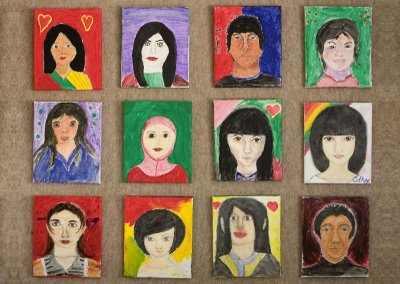
- Next–The children draw their own portrait on the pre-made crayon patterns–when complete–have children cut out their crayon self-portrait.
The self-portraits are then placed in a “giant box of crayons” shape– that you can create using construction paper. - The children’s pictures are lined up next to each other and in rows—just as crayons in a crayon box would be.
THE CRAYON BOX THAT TALKED
Poem by: Shane DeRolf
While walking into a toy store the day before today
I overheard a crayon box with many things to say
“I don’t like Red!” said Yellow and Green said “Nor do I”
“And no one here likes Orange but no one knows just why”
“We are a box of crayons that doesn’t get along
Said Blue to all the others “Something here is wrong”
Well, I bought that box of crayons and took it home with me
And laid out all the colors so the crayons all could see
They watched me as I colored with Red and Blue and Green
And Black and White and Orange and every color in between
They watched as Green became the grass and Blue became the sky
The Yellow sun was shining bright on White clouds drifting by
Colors changing as they touched becoming something new
They watched me as I colored – they watched me till I was through
And when I finally finished I began to walk away
And as I did the crayon box had something more to say
“I do like Red!” said Yellow and Green said, “so do I”
And Blue you were terrific! So high up in the sky
“We are a box of crayons each one of us unique
But when we get together the picture is more complete”
WOULDN’T IT BE TERRIBLE…?
A Poem that Might work with one of your Activities…
Wouldn’t it be terrible? Wouldn’t it be sad?
If just one single color was the color that we had?
If everything was purple? Or red? Or blue? Or green?
If yellow, pink, or orange was all that could be seen?
Can you just imagine how dull world would be
If just one single color was all we got to see?
INTRODUCE OTHER LANGUAGES AND SIGN LANGUAGE…
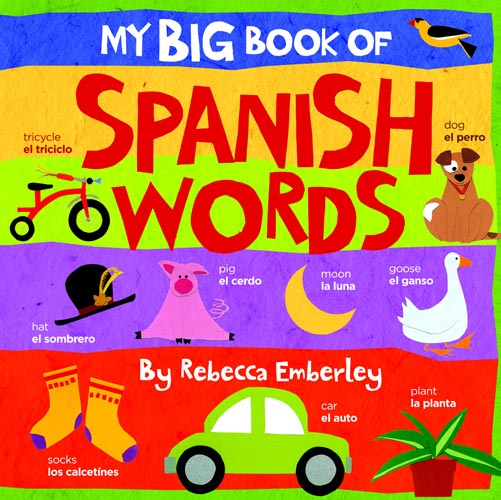
Explore and become familiar with other languages. Both the sound of the language and the written word. Learn simple greetings. Learn to count. It can be presented in a class or club format…
For younger children, present with music and games…counting, greetings. etc. Make it fun!
This can get you started…
 LEARN TO SAY “HELL-O”
-
Arabic: Marhabah (mar-ha-bah)
-
French: Bonjour (bone-joor)
-
Hebrew: Shalom (shah-lome)
-
Italian: Buon giorno (bone-zhee-or-no)
-
Mandarin Chinese: Nea how (nee-how)
-
Russian: Priviet (pri-vee-et)
-
Spanish: Hola (oh-la)
-
Swahili: Jambo (zham-boh)
LEARN “THANK YOU”
-
Afrikaans: dankie (dahn-kee )
-
Arabic: shukran (shoe-krahn )
-
Australian English: (ta) (informal) Pronouned “tar”
-
Chinese, Cantonese: do jeh (daw-dyeh )
-
Chinese, Mandarin: xie xie (syeh-syeh )
-
Czech: dêkuji (deh-ku-yih)
-
Danish: tak (tahg)
-
Finnish: kiitos (kee-toas)
-
French: merci (mehr-see)
-
German: danke (dahn-kah)
-
Greek: efharisto (ef-har-rih-stowe)
-
Hebrew: toda (toh-dah )
-
Hindi, Hindustani: sukria (shoo-kree-a )
-
Indonesian/Malayan: terima kasih (t’ree-ma kas-seh)
-
Italian: grazie (gra-see)
-
Japanese: arigato (ahree-gah-tow )
-
Korean: kamsa hamnida (kahm-sah=ham-nee-da)
-
Norwegian: takk (tahk )
-
Philippines: Tagalog) salamat po (sah-lah-maht poh)
-
Polish: dziekuje (dsyen-koo-yeh)
-
Portuguese: obrigado (oh-bree-gah-doh)
-
Russian: spasibo (spah-see-boh)
-
Spanish: gracias (gra-see-us)
-
Sri Lanka/Sinhak: istutiy (isst-too-tee)
-
Swahili: asante (ah-sahn-teh)
-
Swedish: tack (tahkk)
-
Thai: kawp-kun krap/ka’ (kowpkoom-krahp/khak )
-
Turkish: tesekkür ederim (teh-sheh-kur=eh-deh-rim )
‘HELLO & THANK YOU’ ACTIVITY IN DIFFERENT LANGUAGES…
The goal of this activity is to heighten cross-cultural awareness, celebrate cross-cultural knowledge, and to say “hello” (and thank-you) in many different languages. This can be used as a warm-up, get-to-know-you activity with a cross-cultural theme. Within a group, you may be surprised how much knowledge there is of different languages for basic phrases.
Optional: Ask participants to see if they can guess how many people there are in the world and how many different languages are spoken. (There are ~2800 languages and ~6 billion people. If an equal number of people spoke each language that would be ~ 2 million people per language. You might relate this to local city/town size.).
Challenge the group to come up with as many different languages for “hello” or “thank-you” as possible. When somebody volunteers (e.g., Bonjour!), make sure they say it or repeat it clearly for the rest of the group— who then repeat.
Optional: Before people start making suggestions, ask the group to have a guess to how many collective languages the group will be able to come up with. Don’t allow discussion – just do a quick survey–and take a rough average – that’s the group’s estimate.
The group leader keeps count on his/her fingers.
Was the final number of “hellos or thank-you’s in different languages” close to the group’s guess? If the group underestimated, they may not realize the knowledge within the group that might be used to their advantage. If the group’s guess was an overestimate, why did they overestimate their knowledge resources? Discuss.
Optional – to make more difficult or to add variation, try asking for these basic phrases:
Hello…Goodbye
Hello, My name is…?
Hello, How are you?
Yes…No
Please…
Do you speak English?
Numbers 1-5 or 1-10
Optional, but recommended – have a list of hello/thank-you in several different languages from which you can read out. This is especially useful for groups who don’t know many different languages, as well as to learn, have fun, and illustrate the range of different languages.
PEN PALS!!!
‘KIDS MEETING KIDS!’ helps young people by helping them to find ways to speak for themselves, take care of each other and the larger community around them.
- 400,000 children from many countries are writing to each other. They write about themselves, their interest, their families, schools, hobbies, questions about what’s going on in the world, concerns they have about their countries, other kids and how they feel about wars, children’s rights, and other world issues.
- From their penpals, they learn what it’s like to live in another country and culture, and how another young person sees the world. The penpals often find that they have more things in common than they don’t.
- Kids Meeting Kids helps link kids around the world. To see how to join VISIT HERE.
THE CASE FOR INTRODUCING FOREIGN LANGUAGE TO YOUNG CHILDREN…
Infants as young as 4 months who live in bilingual environments can distinguish between two languages, monitoring lip and facial movements. Babies also show a strong preference for the language their mother spoke during pregnancy.
Contrary to conventional wisdom, bilingual children are not delayed in language acquisition. In fact, words learned before age 5 have an added emotional kick, regardless of how many languages are learned. Because the child’s brain is developing so quickly, across so many regions, the words learned during this critical period carry thick visual and emotional associations….
Bilingualism enhances attention and cognitive control in kids and adults. Also bilinguals are better at learning additional languages, even if those languages bear little resemblance to the ones they already know.
Source: Psychology Today (October 2010; psychologytoday.com)
CULTURE & GEOGRAPHY
Learning about other people and cultures promotes understanding and acceptance. Help children learn about our differences and similarities and appreciate cultural diversity.
- Study other cultures.
- Learn the flags from other countries.
- Have cooking projects of special foods from around the world.
- Explore how we all have the same basic needs.
- Have items from other cultures available to explore.
- Older children can do research and reports of countries and their people.
- Explore the cultural challenges within our own nation.
- Explore prejudice.
- Explore the various religions within the classroom, and then extend it to the world.
- Explore how all of us, even within the same culture, are alike yet different.
- Read stories and poems.
HUMAN FAMILY
By Maya Angelou
I note the obvious differences
in the human family.
Some of us are serious,
some thrive on comedy.
Some declare their lives are lived
as true profundity,
and others claim they really live
the real reality.
The variety of our skin tones
can confuse, bemuse, delight,
brown and pink and beige and purple,
tan and blue and white.
I’ve sailed upon the seven seas
and stopped in every land,
I’ve seen the wonders of the world
not yet one common man.
I know ten thousand women
called Jane and Mary Jane,
but I’ve not seen any two
who really were the same.
Mirror twins are different
although their features jibe,
and lovers think quite different thoughts
while lying side by side.
We love and lose in China,
we weep on England’s moors,
and laugh and moan in Guinea,
and thrive on Spanish shores.
We seek success in Finland,
are born and die in Maine.
In minor ways we differ,
in major we’re the same.
I note the obvious differences
between each sort and type,
but we are more alike, my friends,
than we are unalike.
We are more alike, my friends,
than we are unalike.
We are more alike, my friends,
than we are unalike.